Investigations
FBI
Immediately after the attacks, the Federal Bureau of Investigation started PENTTBOM, the largest criminal inquiry in the history of the United States. At its height, more than half of the FBI's agents worked on the investigation and followed a half-million leads. The FBI concluded that there was "clear and irrefutable" evidence linking al-Qaeda and bin Laden to the attacks.
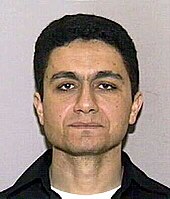
The FBI was quickly able to identify the hijackers, including leader Mohamed Atta, when his luggage was discovered at Boston's Logan Airport. Atta had been forced to check two of his three bags due to space limitations on the 19-seat commuter flight he took to Boston. Due to a new policy instituted to prevent flight delays, the luggage failed to make it aboard American Airlines Flight 11 as planned. The luggage contained the hijackers' names, assignments, and al-Qaeda connections. "It had all these Arab-language sic papers that amounted to the Rosetta stone of the investigation", said one FBI agent. Within hours of the attacks, the FBI released the names and in many cases the personal details of the suspected pilots and hijackers. On September 27, 2001, they released photos of all 19 hijackers, along with information about possible nationalities and aliases. Fifteen of the men were from Saudi Arabia, two from the United Arab Emirates, one from Egypt, and one from Lebanon.
By midday, the U.S. National Security Agency and German intelligence agencies had intercepted communications pointing to Osama bin Laden. Two of the hijackers were known to have travelled with a bin Laden associate to Malaysia in 2000 and hijacker Mohammed Atta had previously gone to Afghanistan. He and others were part of a terrorist cell in Hamburg. One of the members of the Hamburg cell was discovered to have been in communication with Khalid Sheik Mohammed who was identified as a member of al-Qaeda.
Authorities in the United States and United Kingdom also obtained electronic intercepts, including telephone conversations and electronic bank transfers, which indicate that Mohammed Atef, a bin Laden deputy, was a key figure in the planning of the 9/11 attacks. Intercepts were also obtained that revealed conversations that took place days before September 11 between bin Laden and an associate in Pakistan. In those conversations, the two referred to "an incident that would take place in America on, or around, September 11" and they discussed potential repercussions. In another conversation with an associate in Afghanistan, bin Laden discussed the "scale and effects of a forthcoming operation." These conversations did not specifically mention the World Trade Center or Pentagon, or other specifics.
| Nationality | Number |
|---|---|
| Saudi Arabia | 15
|
| United Arab Emirates | 2
|
| Egypt | 1
|
| Lebanon | 1
|
The FBI did not record the 2,977 deaths from the attacks in their annual violent crime index for 2001. In a disclaimer, the FBI stated that "the number of deaths is so great that combining it with the traditional crime statistics will have an outlier effect that falsely skews all types of measurements in the program's analyses." New York City also did not include the deaths in their annual crime statistics for 2001.
CIA
The Inspector General of the Central Intelligence Agency (CIA) conducted an internal review of the agency's pre-9/11 performance and was harshly critical of senior CIA officials for not doing everything possible to confront terrorism. He criticized their failure to stop two of the 9/11 hijackers, Nawaf al-Hazmi and Khalid al-Mihdhar, as they entered the United States and their failure to share information on the two men with the FBI. In May 2007, senators from both major U.S. political parties drafted legislation to make the review public. One of the backers, Senator Ron Wyden said, "The American people have a right to know what the Central Intelligence Agency was doing in those critical months before 9/11."
Congressional inquiry
In February 2002, the Senate Select Committee on Intelligence and the House Permanent Select Committee on Intelligence formed a joint inquiry into the performance of the U.S. Intelligence Community. Their 832-page report released in December 2002 detailed failings of the FBI and CIA to use available information, including about terrorists the CIA knew were in the United States, in order to disrupt the plots. The joint inquiry developed its information about possible involvement of Saudi Arabian government officials from non-classified sources. Nevertheless, the Bush administration demanded 28 related pages remain classified. In December 2002, the inquiry's chair Bob Graham (D-FL) revealed in an interview that there was "evidence that there were foreign governments involved in facilitating the activities of at least some of the terrorists in the United States." September 11 victim families were frustrated by the unanswered questions and redacted material from the Congressional inquiry and demanded an independent commission. September 11 victim families, members of congress and the Saudi Arabian government are still seeking release of the documents. In June 2016, CIA chief John Brennan says that he believes 28 redacted pages of a congressional inquiry into 9/11 will soon be made public, and that they will prove that the government of Saudi Arabia had no involvement in the September 11 attacks.
In September 2016, the Congress passed the Justice Against Sponsors of Terrorism Act that would allow relatives of victims of the September 11 attacks to sue Saudi Arabia for its government's alleged role in the attacks.
9/11 Commission
The National Commission on Terrorist Attacks Upon the United States (9/11 Commission), chaired by Thomas Kean and Lee H. Hamilton, was formed in late 2002 to prepare a thorough account of the circumstances surrounding the attacks, including preparedness for and the immediate response to the attacks. On July 22, 2004, the Commission issued the 9/11 Commission Report. The report detailed the events of 9/11, found the attacks were carried out by members of al-Qaeda, and examined how security and intelligence agencies were inadequately coordinated to prevent the attacks. Formed from an independent bipartisan group of mostly former Senators, Representatives, and Governors, the commissioners explained, "We believe the 9/11 attacks revealed four kinds of failures: in imagination, policy, capabilities, and management". The Commission made numerous recommendations on how to prevent future attacks, and in 2011 was dismayed that several of its recommendations had yet to be implemented.
National Institute of Standards and Technology
The U.S. National Institute of Standards and Technology (NIST) investigated the collapses of the Twin Towers and 7 WTC. The investigations examined why the buildings collapsed and what fire protection measures were in place, and evaluated how fire protection systems might be improved in future construction. The investigation into the collapse of 1 WTC and 2 WTC was concluded in October 2005 and that of 7 WTC was completed in August 2008.
NIST found that the fireproofing on the Twin Towers' steel infrastructures was blown off by the initial impact of the planes and that, had this not occurred, the towers likely would have remained standing. A 2007 study of the north tower's collapse published by researchers of Purdue University determined that, since the plane's impact had stripped off much of the structure's thermal insulation, the heat from a typical office fire would have softened and weakened the exposed girders and columns enough to initiate the collapse regardless of the number of columns cut or damaged by the impact.
The director of the original investigation stated that "the towers really did amazingly well. The terrorist aircraft didn't bring the buildings down; it was the fire which followed. It was proven that you could take out two-thirds of the columns in a tower and the building would still stand." The fires weakened the trusses supporting the floors, making the floors sag. The sagging floors pulled on the exterior steel columns causing the exterior columns to bow inward. With the damage to the core columns, the buckling exterior columns could no longer support the buildings, causing them to collapse. Additionally, the report found the towers' stairwells were not adequately reinforced to provide adequate emergency escape for people above the impact zones. NIST concluded that uncontrolled fires in 7 WTC caused floor beams and girders to heat and subsequently "caused a critical support column to fail, initiating a fire-induced progressive collapse that brought the building down".
Alleged Saudi role
In July 2016, the Obama administration released a document, compiled by US investigators Dana Lesemann and Michael Jacobson, known as "File 17", which contains a list naming three dozen people, including the suspected Saudi intelligence officers attached to Saudi Arabia's embassy in Washington, D.C., which connects Saudi Arabia to the hijackers.

Comments
Post a Comment